
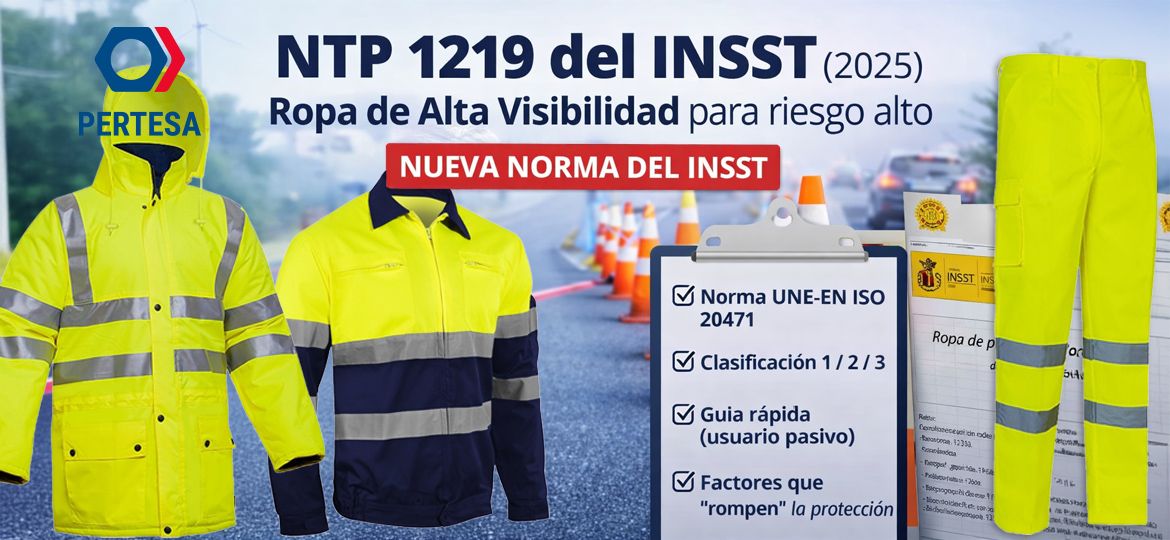
New NTP 1219 (2025) on High Visibility Clothing
The INSST has just published NTP 1219 (2025) on high-visibility clothing. If your team works near traffic or forklifts, this is of interest to you:
This technical note brings together information on PPE capable of visually signalling the presence of the user and, specifically, focuses on high-visibility clothing (HV) for situations with a high risk of being run over (and updates/replaces NTP 718).
If you purchase/manage PPE or lead occupational risk prevention, here are 5 key ideas to apply right away:
1) Do not confuse ‘HV’ with ‘enhanced visibility’.
- HV (high risk) → UNE-EN ISO 20471 (clothing).
- Enhanced visibility (medium risk) → EN 17353:2020+A1:2025 (includes garments and devices such as armbands/bands).
2) The ‘class’ (1, 2 or 3) is not a sticker: it is visible surface area.
- The class is defined by minimum areas of visible material (background and retroreflective). Note: logos, labels or customisations cannot ‘eat into’ these surfaces.
3) Quick selection by speed (‘passive’ road users).
When there is traffic and the worker is ‘doing something else’ (construction, assistance, emergencies, etc.), the NTP provides clear guidance:
- 15–30 km/h → Class 1.
- 30–60 km/h → Class 2.
- >60 km/h → Class 3.
(Always: risk assessment and actual conditions: weather, traffic density, etc.)

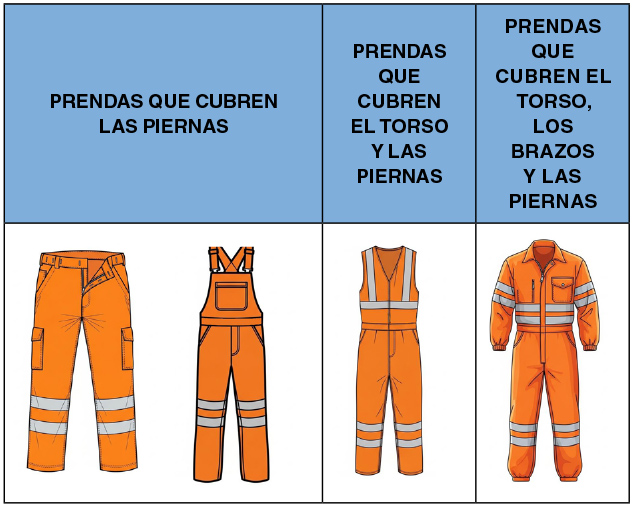
Examples of high-visibility clothing. (source: INSST)
4) High visibility = 360º (design and placement matter).
To ensure visibility from all sides:
- Retroreflective bands + fluorescent material surrounding torso/legs/sleeves.
- Minimum width 5 cm (background material and bands).
- Discontinuities ≤ 5 cm (seams/fastenings).
- Approximately (50 ± 10)% of the minimum background material must be on the front.
5) What most ‘breaks’ the protection is not the purchase… it is the use.
Typical points that lower the class without anyone noticing:
- Not wearing it closed.
- Hems/repairs that affect surfaces or bands.
- Uncontrolled use of logos.
- Not following washing/storage instructions (including keeping away from sunlight) and not monitoring discolouration or damage to bands.
- And if the class is achieved with two garments (e.g. jacket + trousers), they must always be worn together.
Contact us:
If you would like to explore how PERTESA can support your projects, please contact us. We will be happy to share case studies, understand your needs and provide solutions with a technical approach and verified guarantee.
You can contact us by email at comercial@pertesa.com, or by using the contact form on our website.